
In the city of London . . . he had never, in the whole course of his life, found above three or four whom he could call throughly honest.

Tobias Smollett (1721-1771)

In the city of London . . . he had never, in the whole course of his life, found above three or four whom he could call throughly honest.
Tobias Smollett (1721-1771)
On 25 October 1961, Britain’s top satirical magazine was launched from Willie Rushton’s mothers home in Scarsdale Villas. The publication of corny text, printed on yellow paper would develop into Private Eye, which today has a circulation of over ¼ million for its bi-weekly editions. Still published in London it has been edited since 1986 by Ian Hislop and today is better known for its investigative journalism into under-reported scandals.
 On 25 October 1400 Geoffrey Chaucer author of Canterbury Tales died, he was the first writer interred in Poets’ Corner at Westminster Abbey
 Cellars at The Mason’s Arms, Upper Berkeley Street were used as cells for those to be hanged at Tyburn to which there is a connecting tunnel
 St Paul’s Cathedral is the fifth built on the site of a Roman temple dedicated to Diana, the first church was constructed around 604 AD
 Charliatan, Dr. Bossey entertained vast crowds in Covent Garden, but decamped when heckled by who he believed to be a dissatisfied patient, in fact it was a parrot
 King Charles I was the last monarch ever to enter the Chamber of The House of Commons. Today the monarch addresses Parliament in the House of Lords
 William Hogarth’s Times of Day: Night shows 18th century magistrate Thomas de Veil being soaked by urine on Charing Cross Road
 Pimms was invented in 1823 at 3 Poultry at the Pimm’s Oyster Rooms as an aid to digestion serving it in a small tankard known as a No. 1 Cup
 London’s oldest swimming club is the Serpentine SC, founded in 1864, unusually it didn’t adopt first and second class swims
 The Rocket inventor Robert Stevenson proposed the Thames Viaduct Railway a steel structure for trains to travel along the river’s centre
 The majority of workers at Mortons Jam factory were of Scottish origin, this is where the famous blue & white colours of Millwall originated
 The 1,800 people a year granted The Freedom of The City of London can if they should wish herd a gaggle of geese down Cheapside
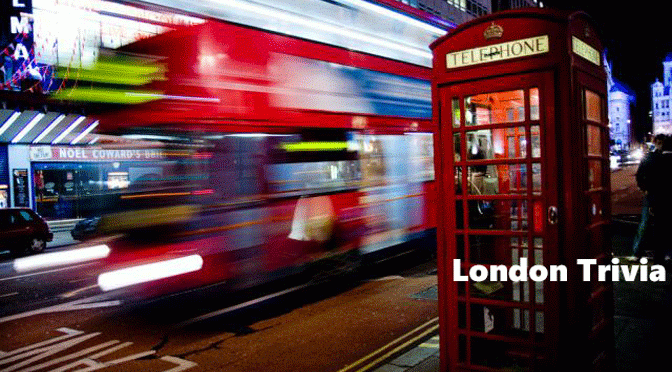
 Trivial Matter: London in 140 characters is taken from the daily Twitter feed @cabbieblog.
A guide to the symbols used here and source material can be found on the Trivial Matter page.
For those new to CabbieBlog or readers who are slightly forgetful, on Saturdays I’m republishing posts, many going back over a decade. Some will still be very relevant while others have become dated over time. Just think of this post as your weekend paper supplement.
Boris described it as “a national treasure of global importance”, and yet one of London’s least-known museums boasts an average of just 10 visitors a day; it is the British Postal Museum & Archive.
We now live in a world of emailing, twittering, texting and Facebooking each other. I’m as bad as the next techie-junkie for why should I be writing this post!), but for over a century-and-a-half we managed to get by with the Royal Mail – Thank you very much.
Currently situated behind Mount Pleasant Sorting Office the archive in its title doesn’t do it justice. A collection of old phone boxes; every sort of pillar box ever built; two million stamps, many never issued and worth thousands; and all houses in two-and-a-half miles of archives.
The museum has its own 6-mile private underground stretching from Paddington to Whitechapel which was in use by the Post Office until 2003. There is also the British Postal Museum Store at Debden, Essex for larger objects.
When producers of the BBC series Lark Rise to Candleford want to recreate an authentic Victorian post office counter, they borrowed an original from here.
During the Blitz, the pillar box was often the only thing left standing on East London’s streets so deep are their foundations, but that should keep these sentinels of our streets immune from thieves with a JCB digger.
In 1874 the Post Office switched from green pillar boxes to the familiar red to make them more visible in urban fog – people kept bumping into them.
As with the telephone box letter writing and posting is becoming rarer, and we need a museum to celebrate this lost art. With £20 million from the National Lottery and a further £5 million from the sale of some of their collection the British Postal Museum & Archive plans to open a proper museum attracting 80,000 visitors a year, and it has plans to reopen a section of the old London Post Office Railway for tourist journeys.
With the imminent sale of Royal Mail, we might one day need a museum to show future generations this uniquely British institution.
London is the greatest show on Earth, for never have so many human characters been gathered together at one place. Here, in a day, you see the world.
Laurie Lee (1914-1997)
On 18 October 1910 Dr Hawley Harvey Crippen’s trial commenced, for the murder of his wife Cora. Lasting only 5 days, the jury took just hours to reach a verdict of guilty. He was executed at Pentonville Prison on 23 November. His notoriety stems from being the first suspect apprehended with the aid of wireless telegraphy as he made his escape to Canada. Cora’s body was found under the basement floor of 39 Hilldrop Crescent.
On 18 October 1660, a proclamation forbidding Hackney carriages to ply for hire was enacted. Pepys records in his diary picking up on the following day
In 1894 Martial Bourdin accidently blew himself up – his funeral sparked riots by 15,000 near the Autonomie Anarchist Club, 6 Windmill Street
The Tower of London once contained a royal residence, barracks, armoury, prison, mint, a menagerie and an observatory
It took Dr John Snow years to persuade the establishment that cholera is the water-borne disease that he proved it to be in Soho in 1854
During the Cold War the statue of St Francis of Asissi at Brompton Oratory was used as a ‘dead letter’ drop for Russian KGB agents
Fassett Square in Dalston was the model for Eastenders’ Albert Square but no pub and the garden is for residents only
Tooting Bec Lido holds 1 million gallons, taking a week to fill, at 300ft x 100ft a maximum of 1,400 swimmers can enter the water at a time
Edgar Kail scored over 400 goals for Dulwich Hamlet FC won 3 England caps and refused to turn professional, Hamlet fans still chant his name
The first deep-level tube trains had no windows, guards called out the station names to advise your location
In the early days of the London and Birmingham Railway conductors travelled outside the train, leaning in through the open windows to check tickets
It would take 7,408 Hula Hoops to reach the height of Big Ben, it’s a claim made by the manufacturers of – well Hula Hoops
Trivial Matter: London in 140 characters is taken from the daily Twitter feed @cabbieblog.
A guide to the symbols used here and source material can be found on the Trivial Matter page.